
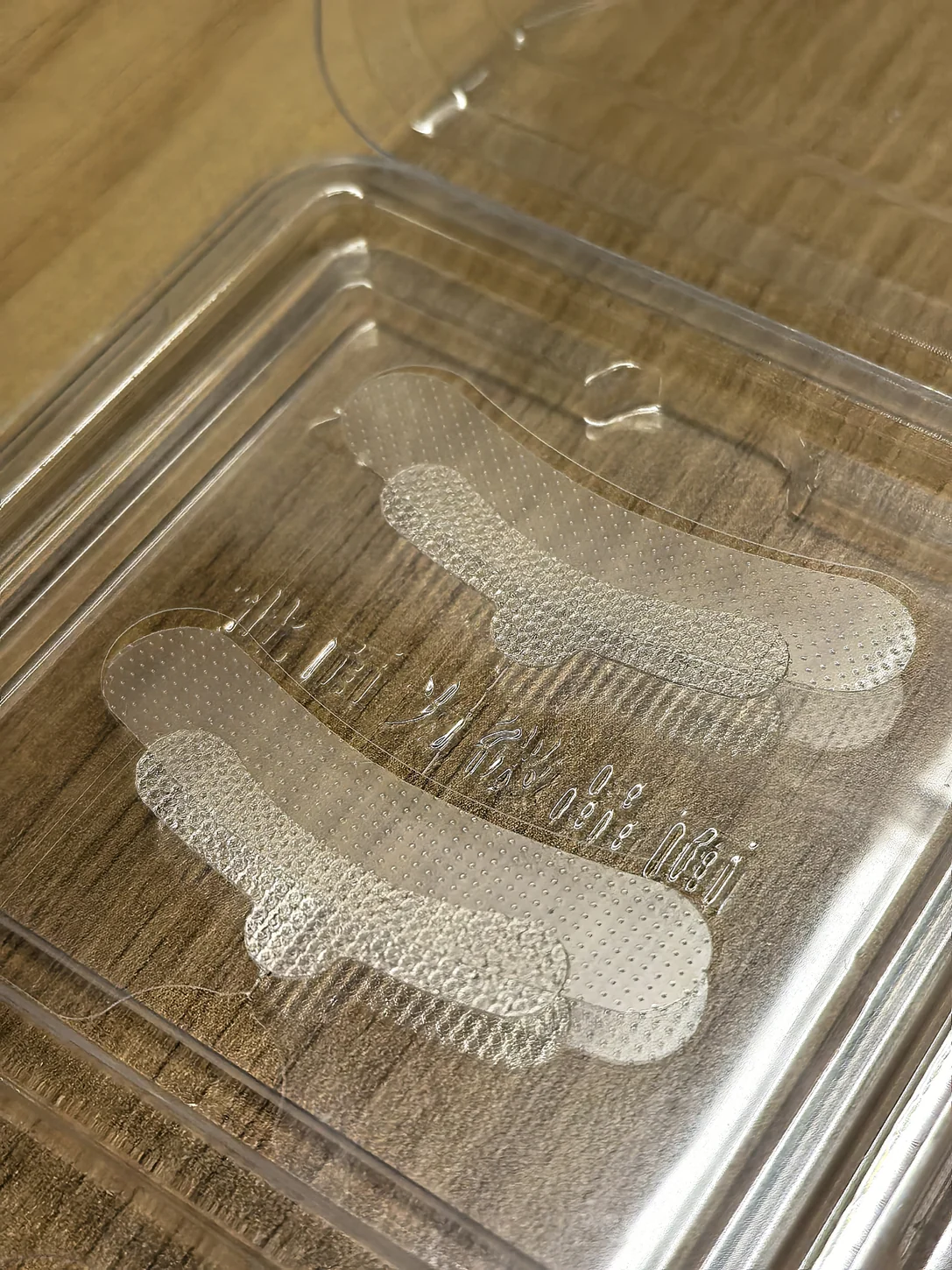
Follow the actual hand movement
Lay the closed tray in its intended orientation. Lift the lid, remove the first liner and turn the patch as a user would. Mark which side faces the user at each point. Look for steps where a printed left or right appears in reverse through a transparent layer.
Test the cue without a demonstration
Give a fresh pair and the draft opening instructions to a reviewer who has not seen the sample. Ask which patch they would pick first and how they decided. Observe the sequence using the sample on a model outline. Save the exact point at which they need more information.
Choose where the cue belongs
Compare a mark on the carrier, a directional line in the opening diagram and a tray that locates the two pieces differently. Check artwork cost and disposal of the marked component. Confirm the selected convention on both sizes if a small and a large pair share one pack design.
Frequently asked questions
Whose left does a left-side marking mean?
Make the convention explicit in the drawing and consumer illustration. A wearer-facing diagram and an observer-facing packing photograph can show the same pair in opposite positions.